
SUPPORT NHS STRIKES
By Marcel Salay
Caterers, porters, cleaners and patient transport workers at Epsom and St Helier’s hospitals in Surrey have struck a deal after a successful strike ballot in early November. Represented by UVW, the workers had previously been denied proper pensions, sick pay from day one, unsociable hours enhancements and other benefits that NHS workers are owed. The workers had won an in-house campaign four years ago but still remained locked out from proper NHS terms and conditions. Some of the workers had been underpaid £10,000 a year. 500 workers secured the deal after an impressive 98 per cent vote in the ballot to strike demonstrated rank-and-file militancy was a credible threat to management.

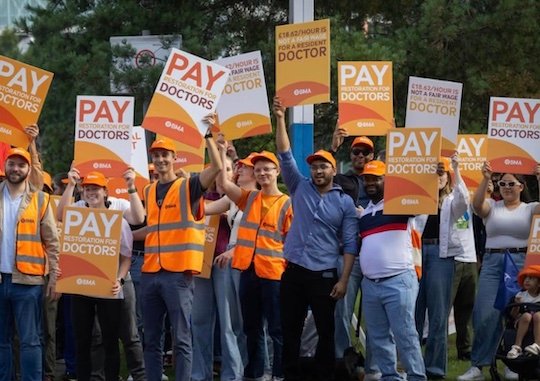
Over 17,000 resident doctors (formerly known as junior doctors) across the NHS were also in an ongoing dispute. They went out on strike in mid-November. Numbers were up from a previous strike over the summer and the NHS estimates it cost £240 million to cover their roles. Wes Streeting’s (Secretary of State for Health and Social Care) offer just prior to the strike did not serious deal with the BMA’s key demands. First of which was to restore pay to the levels they were in 2008. After years of stagnating wages, resident doctors have had 21% pay cut against inflation since 2008 and that’s even after a deal in 2022 (during the strike wave) which reined it in slightly from 32% at the time. Secondly to sort out the bottle neck in training places for specialities. After two years of foundation training, doctors apply for training pathways (GP, emergency medicine, paediatrics etc.) but there are not enough funded places leaving many qualified doctors unemployed or leaving the NHS.
Despite the significant numbers out, only one picket was organised at a single hospital in London where workers from other hospitals could go. There was not much of a sign that there even was a strike on at the other hospitals.
Nativism
The issue around training pathways has caused a stir in the BMA. A motion was passed in June 2025 in favour of prioritising UK med school graduates over international medical graduates (IMGs) in the speciality training pathways. While protecting IMGs already in the NHS in some ways, the position splits the workforce based on crude nationalism. Dated arguments have circulated about the downward pressure on wages that migrants have and even frankly racist commentary about IMGs not being suitable for the NHS due to cultural differences. These fissures reveal a weakness in the industrial power of the workforce and a economism that blights trade union politics.
The BMA could demand training places for all qualified applicants, of course. There is a clear under supply of fully qualified doctors that such a policy would alleviate. The IMGs, who are mostly from Britain’s former colonies in Asia and Africa, might also one day return to their countries as specialists and so contribute to the building up of healthcare sectors there too – a small counterbalance to the imperialist extraction of skills from the Global South. Instead, the position concedes ground to attacks from the right on migrant across Britain.
The rebuttal that resources are too stretched to pay for staff and training rings hollow when trust CEOs sit comfy on salaries north of £240,000 and £330m is awarded to US surveillance-tech company Palantir to amalgamate patient data (1). The latter decision is seen by data scientists in the NHS as ‘convoluted’ and ‘a waste of everyone’s time and public money’ when similar, existing tools could be delivered at a ‘fraction of the cost’ (Corporate Watch, 2025).
Connecting with the rest of the workforce and beyond
The BMA London Regional Council did issue a strong statement of solidarity to the Epsom and St Helier’s workers and promised to donate to the UVW strike fund. More needs to be done, however. Increasing numbers of NHS staff are being outsourced and privatised. Yet, the trade unions at present do not have a strategy that matches the scale of the problem. The status quo of craft unions in healthcare separates workers from each other. Bureaucracy and economism impede solidarity between health workers and blind us to the reality that only an industrial alliance of nurses, support staff, paramedics, doctors, and administrators coordinating a defensive struggle can keep hopes for a nationalised health service alive.
Free health care at the point of delivery has long been the pride of the NHS but risks becoming a relic if we do not divert the current course.
The workers must coordinate in defending staff from precarity and push back against the draconian conditions in the NHS. Further, we must politicise workplace disputes beyond pay and conditions. It would be the first major milestone in building power to re-nationalise the NHS under control of workers and users. With successive governments parcelling off sections of the NHS to private companies on a whim, workers are responsible for standing firm against the tide. Rank and file organisation across whole workplaces is the path forward.
The ISL calls for:
• For a fully comprehensive, integrated, publicly accountable and publicly provided, free at the point of delivery NHS, based on need without privatised franchises.
• Re-nationalise the NHS and social care under the control of workers and users.
(1)No Palantir in the NHS and Corporate Watch Reveal the Real Story Behind the Federated Data Platform Rollout – Corporate Watch. Corporate Watch