
Kashmir: The Rise of a New Mass Movement
Martin Ralph
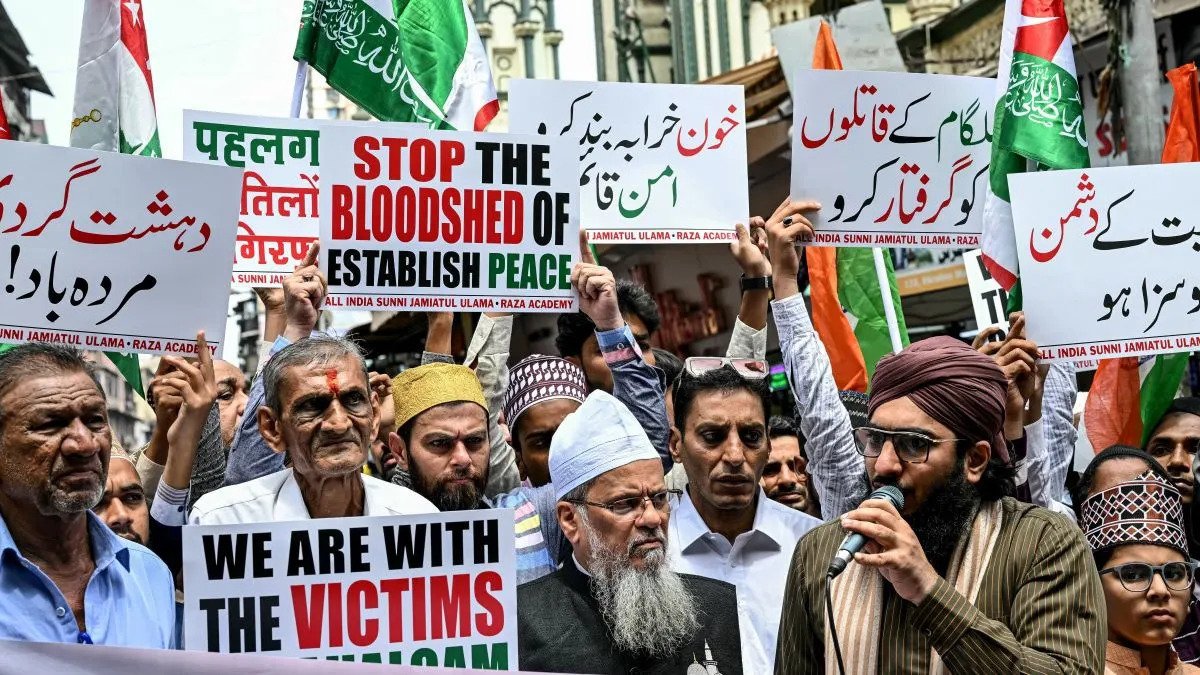
A powerful mass movement has emerged in Pakistan-administered Azad Jammu and Kashmir (AJK), challenging the region’s political establishment and demanding greater democratic and economic rights. Bringing together traders, lawyers, students and community leaders, the movement has grown out of demonstrations that began in 2023 against the soaring cost of living, particularly the price of flour and electricity. What started with demands for economic relief has since developed into a much broader struggle over democratic governance and control of the region’s economic development.1
In September 2023, these committees coalesced into the Joint Awami Action Committee (JAAC). Their demands included economic subsidies, investigations into alleged corruption, improved social services and infrastructure, and the abolition of the 12 reserved seats of the ruling party in Islamabad, Pakistan, which has excessive influence over the regional assembly. JAAC demand democratic governance and control over the region’s economic development.
The demands were not implemented so the committee called a wave of mass strikes and demonstrations in 2024 and 2025.
On September 29, 2025, a complete blackout and strict security measures were imposed in AJK, however people defied the measures and what started in 2023 as protests against inflation and flour and electricity prices, was transformed into a broad-based people’s movement with a 38-point agenda.
Following mass protests, the government accepted 36 of the Charter’s demands with a three-month timeline for implementation, however they were not implemented. JAAC called for a long march on June 9, 2026.
State bans JAAC and attacks violently
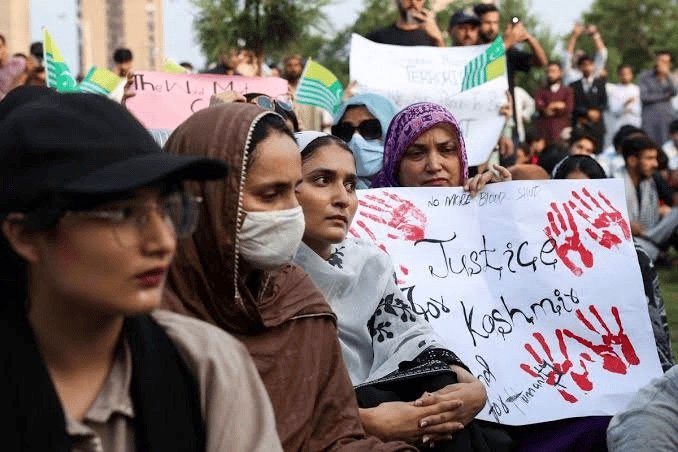
In June the regional government banned the JAAC, citing threats to public order, and detaining dozens of supporters.
Right-wing thugs attacked the marchers, who were branded as extremists or enemies of the state. The state, rather than employing the army and police, had deployed a right-wing party (Muslim Conference), to avoid direct confrontation with the millions who were protesting which would undermine the legitimacy of the Pakistani state in Kashmir.
On 30 June Pakistani authorities arrested JAAC core member Shaukat Nawaz Mir, in an attempt to break the movement. So, within days of Mir’s arrest the Committee issued a call for mass marches, demonstrations and strikes for 5 July 2026 throughout AKJ.
What emerged was not just a series of demonstrations but the early characteristics of a society learning to organise itself under conditions of sustained political confrontation. The movement increasingly relied not upon formal institutions but upon collective organisation developed from below.
What happened on 5 July 2026 marks the moment when thousands of ordinary people demonstrated that political legitimacy does not arise from coercion, but from the active participation in society itself. The events of the day did not resolve Kashmir’s political crisis but ensured it could no longer be dismissed as a temporary disturbance, revealing a society determined to defend its democratic rights and a movement whose significance now extends far beyond the Himalayan mountains.
The JAAC appealed to hundreds of thousands of the Kashmiri diaspora – in Britain, Europe, North America and the Middle East. Their economic contributions through remittances, their political influence within diaspora communities and their growing engagement with trade unions, human rights organisations and democratic movements make them an indispensable part of Kashmir’s political future.
The Kashmiri diaspora in Britain is organising solidarity protests and public meetings to assist the struggle for Kashmiri independence.
How did Kashmir Emerge
The Indian struggle for independence emerged from the revolutionary uprisings of India’s peasantry, working class and youth against British rule in 1946. India could not have gained independence without the intervention of the working class and peasantry, against the wishes of the Congress party who were prepared to compromise with the British to maintain their privileges. The partition of India followed communal violence between Hindus and Muslims which assumed the level of a civil war in Punjab and parts of Northern and Eastern India. Consolidation of this process took the form of a scramble between India and Pakistan.
Kashmir is a country under occupation, since 1948 a deep-rooted struggle for self-determination has been fought by its people against India and Pakistan. As China entered the conflict, disputing the Indo-Chinese border, Kashmir is now split in three.
Today with capitalism in crisis, Indian capital seeks to ruthlessly subjugate Kashmir, pushing for control of Himalayan resources from China, meanwhile, the Pakistani military regime continues its oppression and exploitation of Kashmir.
- This article is informed by material written by Mehnatkash Tehreek (Pakistan) and Mazdoor Inquilab (India) explaining the struggle for independence against Indian and Pakistani occupation. (see newwavesouthasia.com) ↩︎