
End criminalisation of migrants!
By Abel Brandao
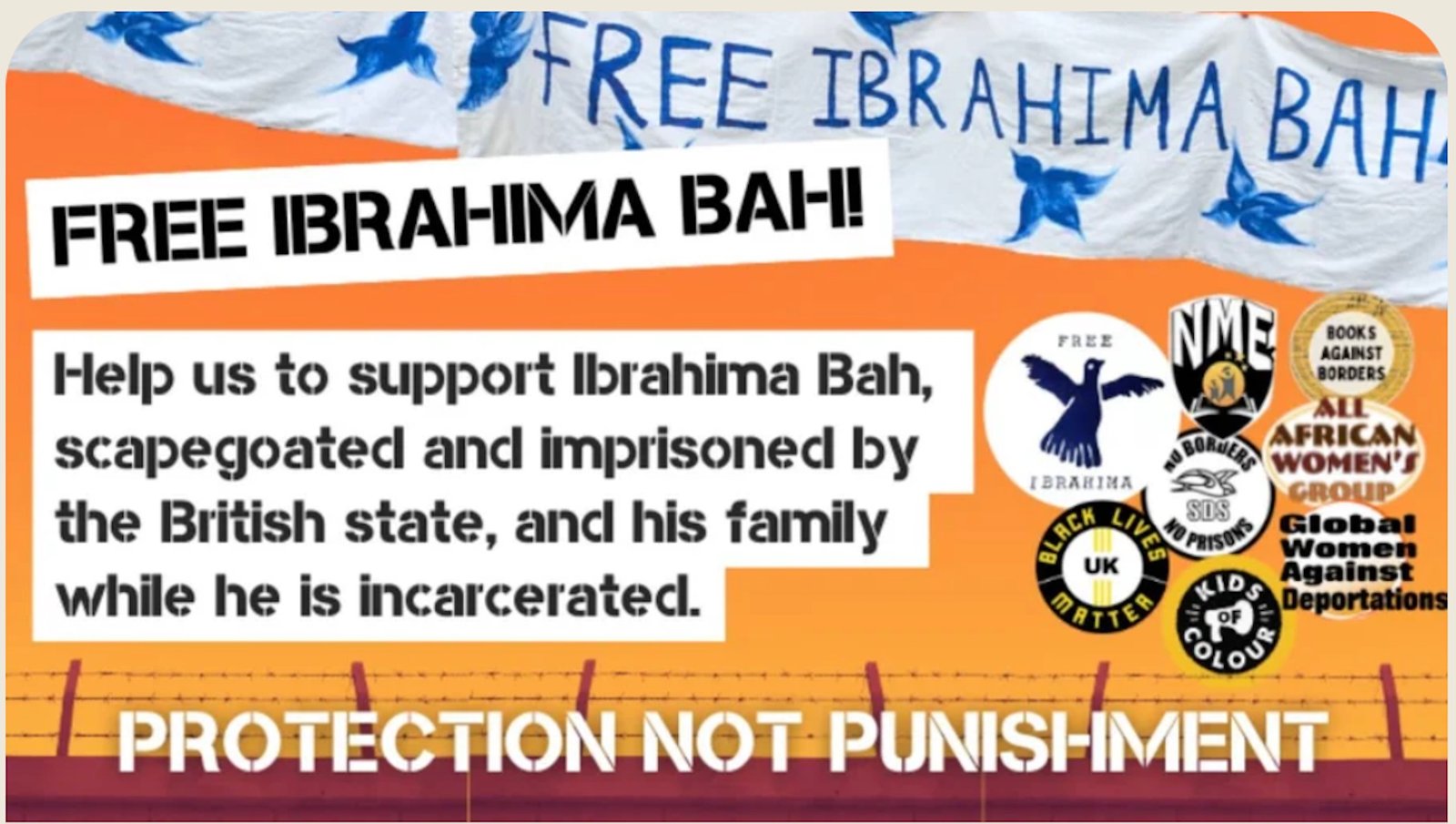
On December 15 a coalition of migrant solidarity groups, anti-racist and anti-border groups took part in a vigil and protest at the Home Office in London. The action marked 3 years since the tragic death of 4 people in the Channel between England and France (the bodies of five others were never found), when the dinghy on which they were trying to reach the UK collapsed, as some of the passengers stood hoping to be picked up by a passing fishing trawler. These deaths are the result of the violent border policies that criminalise people on the move with no ‘safe and legal’ routes for such refugees to come access. The government sought to scapegoat Ibrahima Bah, a Senegalese teenager, when he was handed a 9.5 year sentence for charges of gross negligence manslaughter and facilitating illegal entry to the UK, despite the judge accepting that he did not bear ‘primary responsibility’ for the deaths.
The state and media have created a moral panic around people arriving on ‘small boats’ to the UK from France, portraying them as a threat. New legislation, passed almost annually since 2022, has massively ramped up the criminalisation of people seeking asylum, resulting in hundreds of prosecutions and deportations. So-called ‘captains’ – often those with the least economic resources who drive the boat as they cannot afford to pay passage – have become a particular target of government repression. In 2024, 155 people were charged with ‘illegal arrival’ having arrived on a ‘small boat’, and 127 convicted. Of those charged, 88 were identified as steering, and 62 of these people were convicted.
Ibrahima Bah’s case reflects this pattern, which stands out due to the exceptionally harsh sentence which fails to consider his youth and vulnerability. The circumstances of his journey shine a light on the raw injustice that animates each and every case. When seeing the ‘boat’ he was supposed to steer, Ibrahima at first refused, saying it was too small for the number of passengers. But he was coerced and threatened at knife point so had no choice but to steer the unsafe ‘boat’.

There was nothing inherently dangerous in Ibrahima’s handling of the ‘boat’, as water started to enter the boat distress calls made were made, yet nearby French vessels did not respond. The channel between Britain and France is heavily surveilled, with billions of pounds spent on border security, yet distress calls were ignored. As the dinghy crossed paths with an English fishing vessel, it was still afloat; people stood up to call for attention and rescue which worsened the damage causing the dinghy to collapse and sink. The fishing vessel’s captain admitted to prioritising taking photographs of the people in the water, later appearing on GB News critical of the UK government for being too lenient in allowing migrants to cross the channel.
Survivors testified that Ibrahima was “like an angel” for the way he helped pull people out of the water. Despite other similar situations which were resolved without loss of life due to more diligent responses from nearby vessels, Ibrahima became the sole scapegoat, and the teenager handed a 9.5 year prison sentence. Whilst his first trial resulted in a hung jury, a second, all-white jury found Ibrahima guilty. A survivor of the shipwreck testified that the only reason they could be in the court giving evidence was because of Ibrahima’s actions to save their lives. The testimony was not heard by the jury, only by the judge.
While imprisoned, Ibrahima remains principally concerned for his mother, who lives in Senegal. After the shipwreck, British authorities initially informed his mother that Ibrahima had died, mistaking his identity with Ibrahima’s friend who did tragically die. As the only son in the family, Ibrahima carries a responsibility to provide for the family that is obviously frustrated by his incarceration.
The oppression imposed by imperialism stretches from Senegal to the UK and on every step of the treacherous journey in between. The pressures to leave home, the immense costs of crossing borders, and the criminalisation upon arrival are all features of a world system that imposes violence and denies freedom depending on the capital or passport that one has access to. Ibrahima teaches us an immense lesson in resistance and the pursuit of life against murderous systems. His case forces us to reckon with the connections between racism and criminalisation in the UK, the European border regime that stretches beyond Europe, and imperialism and underdevelopment which continue to shape life across Africa.
As Iker Suarez has recently argued in Monthly Review, posing a danger to this murderous system requires us to develop the analysis and strategy that attacks imperialism everywhere it rears its ugly head. We need to think and act in a coordinated way across the different points of the system. From Senegal, across the Sahara, through Libya, across Europe and into the UK, Ibrahima has been forced to confront the full body of imperialism. The campaign to Free Ibrahima Bah seeks to work with allied groups and organisations to win his freedom and build the fight so that no one else would suffer such an injustice Ibrahima has.