
SUPPORT THE HUNGER STRIKE
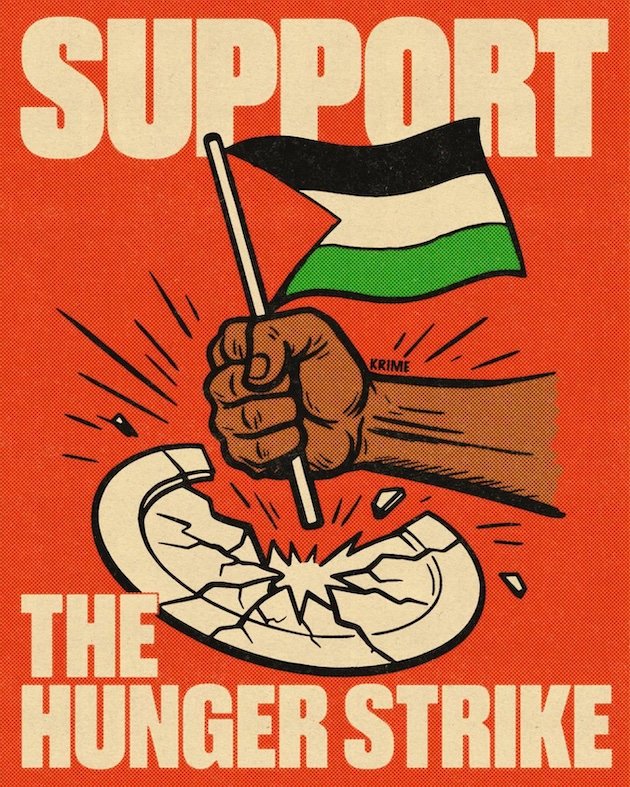
By Abel Brandao
Qesser Zuhrah, Amu Gib, Heba Muraisi, Jon Cink, T Hoxha, Kamran Ahmed and Umer Khalid are on hunger strike in UK prisons. They are amongst 33 people on ‘remand’ – ie locked up awaiting trial for alleged actions with Palestine Action, a direct action group which targeted the infrastructure of the genocide in Palestine here in the UK, until it was banned as a ‘terrorist’ group in July 2025.
The hunger strikers’ demands are: an end to censorship of their communications; immediate bail; the release of all documents relating to their cases to enable a fair trial; the deproscription of Palestine Action; and an end to the UK operations of Elbit Systems, Israel’s largest weapons manufacturer.
Those on remand have spent over 16 months in prison awaiting trial for alleged actions taken in solidarity with Palestine, where the genocide being committed by the zionist state with material and diplomatic backing from Britain and the US, continues. Since the supposed cessation of hostilities on 10 October, hundreds of Israeli ceasefire violations have been recorded and more than 350 Palestinians have been killed; 9100 Palestinians remain locked inside Israeli prisons. Despite the partial suspension of some export licences in September 2024, UK arms exports to Israel reached a record high value this year, and the Ministry of Defence continues to buy equipment and services from Elbit Systems UK.
Britain’s commitment to the zionist project and its violence against Palestinian people is defended through increasing repression of the protest movement at home. The application of ‘terrorism-related’ charges shows the irrationality of the whole terrorist framing – selectively used to target those who militantly challenge imperialist state power. The banning of Palestine Action was noted as an alarming escalation of state authoritarianism, targeting actions that in other contexts would not generate so much establishment concern. Resistance to the ban has persisted in the form of symbolic breaching of the ban by mostly older comrades, thousands of whom have assembled in town squares up and down the country with signs reading “I oppose genocide. I support Palestine Action”.
Whilst legal battles go on over the Palestine Action ban and the trials of some of those on remand begin, the hunger strike is an urgent call to maintain pressure on the UK government and keep the Palestinian liberation struggle in the forefront of our attention. Overcoming targeted mistreatment in prison, the hunger strikers draw on the legacy of political prisoners movements, such as the Irish republican struggle against the British state in the 1980s, as well as of course the ongoing Palestinian prisoners movement.
In 1981, Bobby Sands and nine other republican prisoners died of starvation in prison, before the Thatcher government implemented their demands. As Heba Muraisi said at the beginning of her hunger strike, “I want to make it abundantly clear that this is not about dying, because unlike the enemy I love life, and my love for life, for people, is the reason why I have been incarcerated for 349 days now.”
The profound commitment to resistance from the hunger strikes is startling, and sharpens our focus on the sacrifice inherent in struggling for our collective liberation. On the outside, the Prisoners for Palestine group has been mobilising for protests at the prisons, parliament, at the BBC, and has gained support from political prisoners in Palestine, Italy, as well as elected representatives in the USA and UK. The campaign is battling against deliberate ignorance from the mainstream media and even the mainstream leadership of the Palestine Solidarity movement, PSC.
When publicly challenged, 1 month into the hunger strike which has reached a critical point, David Lammy, UK foreign secretary, claimed still to be unaware of the situation, asking “is this in the UK?”. The strategy of mainstream ignorance must be challenged by more actions, spreading the stories and highlighting the conditions of the hunger strikers. Their campaign cannot be detached from the Palestinian liberation struggle, and the steadfast resistance at all levels of Palestinian society to deny the genocidal goals of the zionist project. Defending those activists here facing repression for taking action against the genocide is a fundamental part of defending and empowering the Palestinian liberation movement here in the UK.
As well as the mobilisations called to amplify the hunger strikes, mobilisations are also being called at Woolwich Crown Court where the Filton24 trial is ongoing. prisonersforpalestine.org hosts statements and updates from the hunger strikers.