
Striking Back: Lessons from a New Wave of Workers’ Struggles
David Santos (London)
A series of strikes has taken place across Britain, reminding us of the methods we have as workers to defend ourselves. Whilst rent and the cost of living keep rising, going on strike for better pay is a tried-and-tested way to maintain the value of our income. Strikes are a clear statement from workers that we refuse to accept the inequality and squeeze on living conditions, whilst bosses and managers continue to make huge profits on the back of our hard work. In this article we will take a look at some of the impressive disputes that have been taking place, and consider what they tell us about the ways forward.
Institute of Cancer Research
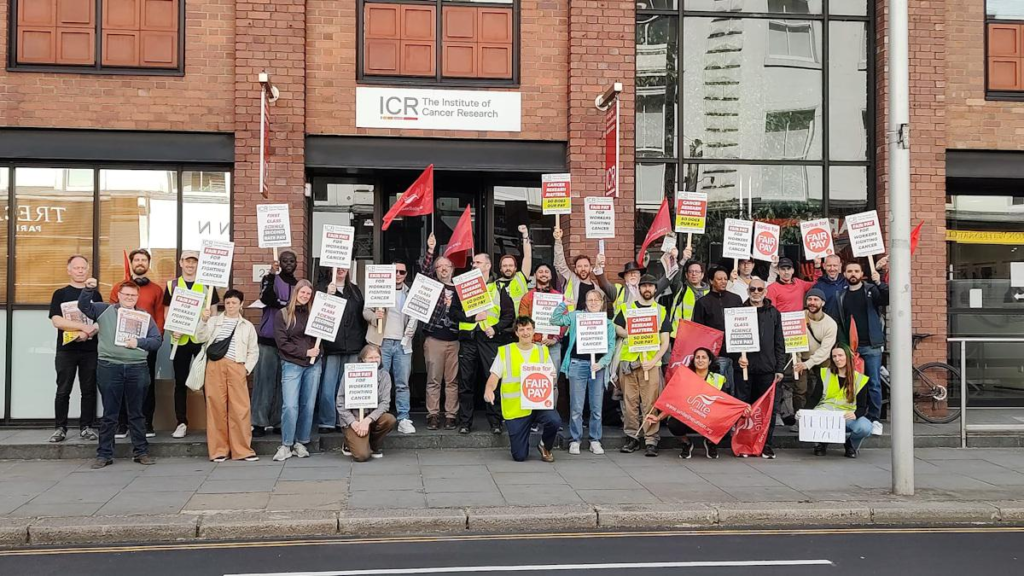
Workers at the Institute of Cancer Research (ICR) started strike action in June after being offered an unsatisfactory 3.75% pay deal. Years of under-inflation pay increases have left many staff facing serious financial difficulties. The strike has been outward-facing, bold, and inspiring to the wider labour movement. The workers have stayed united across departments, despite management efforts to divide the workforce by offering the better-paid workers a deal. They opted for an indefinite strike after piecemeal offers, and the decision has massively strengthened the workers’ position. The workers have visited other union branches around the country, held numerous public rallies, and we trust their efforts and unity will be rewarded in the eventual pay deal.
NHS Upbanding
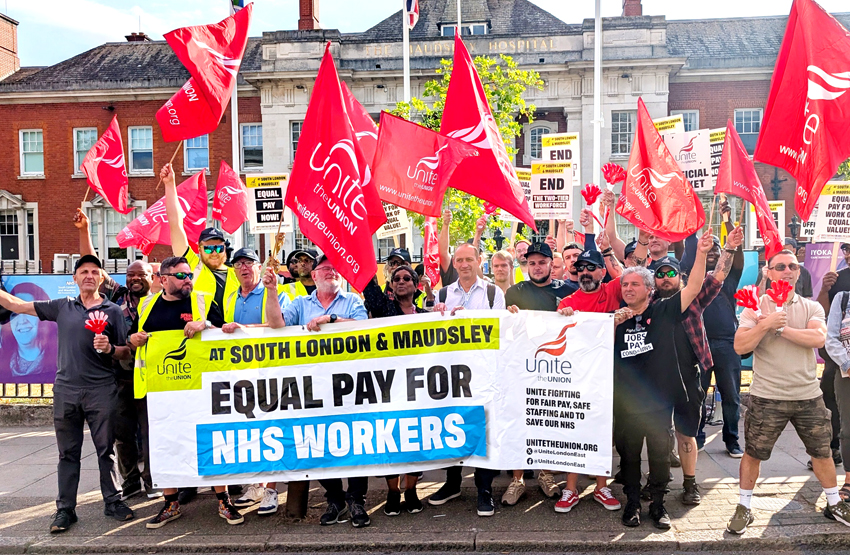
Estates and facilities workers at South London and Maudsley Hospital were on strike in August, also demanding ‘upbanding’ due to pay discrepancies – workers across the road in a different NHS trust can be earning up to £10,000 more per year for doing the same job. They also held lively picket lines and public rallies, putting their dispute in the public eye. Their struggle may be motivated by recent successful ‘upbanding’ campaigns in the NHS, where a particular section of the workforce, for example, phlebotomists at Homerton hospitals, won a strong deal that included significant back pay. Healthcare assistants in Southwest London won a deal in January 2026, and low-paid hospital workers in Glasgow recently voted by 79% to accept a pay deal after 2 days of strikes.
Bus drivers, Tate workers
Beyond the NHS, strikes have been picking up on London buses since late summer over health and safety concerns, after drivers were exposed to temperatures up to 48 degrees Celsius during the summer heatwave. The buses are operated by Aviva, which makes millions whilst refusing to invest in proper air conditioning for drivers. The drivers have announced a series of 24- or 48-hour strikes throughout September into October, which will disrupt the bus network that forms a crucial part of London’s travel infrastructure. Overheating and lack of safety at work have also been raised by workers at the V&A museums, who took strike action in early September, putting forward demands for safe temperatures alongside pay rises.
Lessons, ways forward
What patterns or lessons emerge in this brief overview?
Even the big, traditionally more conservative unions are increasingly accepting that they need to increase militancy and strike action, even just to tread water in this economy. Unite, in particular, has shown itself willing to endorse extensive strike action, as we saw in the Birmingham bin dispute, and now at the ICR and on the buses.
Second, the NHS is fertile ground for organising strong campaigns by low-paid workers, whose earnings have dropped over years of union activity, but where gains can now be made by building industrial strength and committing to strike action.
There remains a looming question of how the labour movement will incorporate the increasingly precarious sections of the working class in Britain. This Autumn, the NEU is launching a nationwide ballot in schools, where the systematic use of agency staff has decimated stability for workers and students alike. And whilst bus drivers in Unite may appeal to TfL to regulate safe working conditions, there are over 100,000 registered private hire drivers in London alone who face the risk of driverless cars entering the market.
We need to develop bold tactics and organise workplaces ‘wall-to-wall’ so that as many workers at a given site as possible are put in motion, regardless of contract type, wage, education level, or immigration status. Socialist militants inside workplaces need to identify and foster leaders, unite different sections of workers, and encourage campaigns to link economic demands to political issues. Developing more conscious militants in the workplace requires building connections between workers in struggle and deepening the analysis that we are, in fact, locked into a wider struggle against the capitalist system.