
Of Silk Purses, Sow’s Ears and Nigel Farage: A Chagos Odyssey
John Kay
During a recent press conference speech following Reform’s gains in the local elections, Nigel Farage criticised the UK government decision to hand the Chagos Islands back to Mauritius, a decision made in recognition of that country’s claim to sovereignty, and the long standing UN resolutions condemning Britain’s creation of the ‘British Indian Ocean territory’ (or BIOT) in the mid 1960’s as a means of retaining control of the Chagos Archipelago. The Chagos Islands had been a British protectorate since the Napoleonic wars and the site of numerous ‘Copra’ or coconut plantations, the mainstay of the Chagos economy.
According to Farage ‘we own the Chagos Islands’ as he called on Donald Trump to put pressure on the UK government to reverse the decision. Farage’s comments are a staggering, toxic whitewashing of an episode in Britain’s imperialist and colonial history. Considering British involvement in the Chagos Islands and British colonialism as a whole, even he cannot make a silk purse out of this particularly rotten sow’s ear.
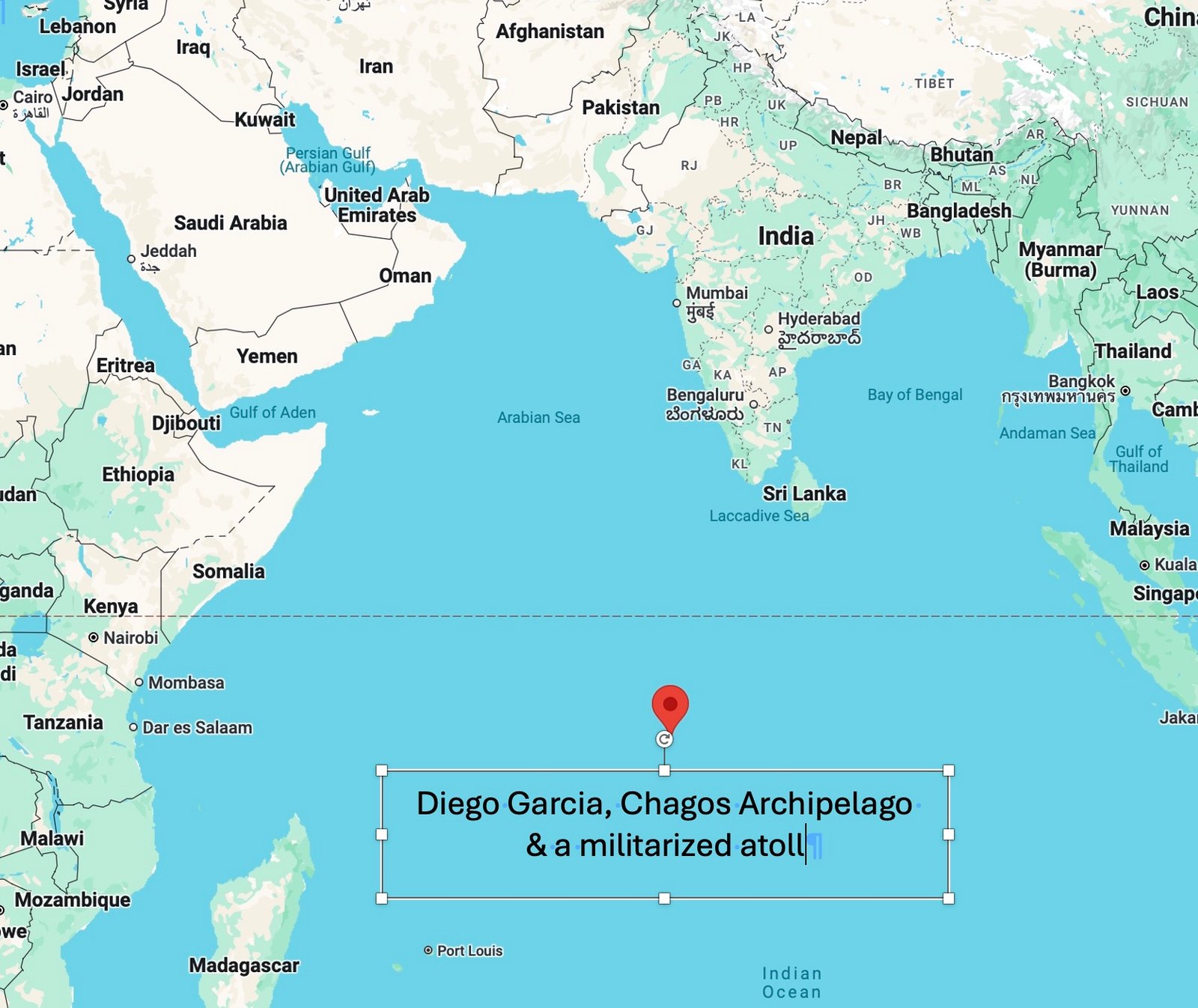
Farage omits to say mention Diego Garcia, one of the main Chagos islands, the subject of a secret and illegal plot between the UK and USA from the mid 1960’s onward, as Britian handed over Diego Garcia to the Americans, in exchange for a discount on the purchase of Polaris missiles. This happened under Harold Wilson’s Labour government, with Dennis Healy as foreign secretary who signed off on the deal, later claiming he was unable to remember doing so!
Farage omitted to acknowledge that Diego Garcia will remain a UK-US military base, according to the May 2025 treaty, While Mauritius has sovereignty over the Chagos Archipelago, including Diego Garcia, the UK retains administrative rights and control over the island, including the 12-nautical mile zone around it, for a 99-year lease (renewable) The UK remains responsible for the defence and security of the island
Cold war, occupation and genocide
The Americans wanted an Indian Ocean naval and air base during the cold war to monitor the Soviet navy and to support US military operations in the Middle East and Africa, Diego Garcia was the perfect location. The islands were inhabited by an indigenous population, descendants of slaves and labourers brought to the islands by the French to work the Copra plantations. These people inhabited the islands for several centuries creating their own rich, distinctive culture based on Copra, fishing, food cultivation, and their own brand of Indian Ocean Sega music. For the Americans and the British, this was a major obstacle to completing the ‘deal’ so the British secretly agreed to forcibly remove the people of Diego Garcia and the other islands to Mauritius and the Seychelles. This was carried out covertly without the knowledge of the UN or the British public, in the late 1960’s and early 70’s.
Islanders were loaded onto ships with a single suitcase of belongings and were literally dumped on the docks of Mauritius and the Seychelles with no resettlement plan, food, accommodation, employment or money. Inevitably, this led to tremendous suffering including disease, starvation and malnutrition, and many islanders died over the ensuing decades. The Chagossians felt they were dying of ‘Chanson de Sagren’ (the acute sadness of separation and despair) and ‘Derasinman’ (a Creole word meaning ‘forced uprooting’). But they have never given up hope and over the last 50 years won several notable verdicts granting them the right to return. However, these rulings were overruled on appeal or ignored by successive UK governments.
Britain’s action in annexing the BIOT and depopulating the islands was in direct contravention of UN directives of the time.
Members of the United Nations which have or assume responsibilities for the administration of territories whose peoples have not yet attained a full measure of self-government recognize the principle that the interests of the inhabitants of these territories are paramount, and accept as a sacred trust the obligation to promote to the utmost, within the system of international peace and security established by the present Charter, the well-being of the inhabitants of these territories, and, to this end: to ensure, with due respect for the culture of the peoples concerned, their political, economic, social, and educational advancement, their just treatment, and their protection against abuses; [Article 73; UN Charter; Chapter XI: Declaration Regarding Non-Self- Governing Territories]
[Genocide] is a structural and systematic destruction of innocent people by a state bureaucratic apparatus… Genocide represents a systematic effort over time to liquidate a national population, usually a minority… [and] functions as a fundamental political policy to assure conformity and participation of the citizenry. (Irving Louis Horowitz)
What was done to the Chagossians was an act of genocide.
This is all fairly unsatisfactory. We detach these islands – in itself a matter which is criticised. We then find, apart from the transients, up to 240 ‘illois’ whom we propose either to resettle (with how much vigour of persuasion?) or to certify, more or less fraudulently, as belonging somewhere else. This all seems difficult to reconcile with the ‘sacred trust’ of Art.73, however convenient we or the US might find it from the viewpoint of defence. It is one thing to use ’empty real estate’; another to find squatters in it and to make it empty. [Handwritten note by unknown Foreign Office official]
We must surely be very tough about this. The object of the exercise was to get some rocks which will remain ours; there will be no indigenous population except seagulls who have not yet got a [UN] Committee (the Status of Women Committee does not cover the rights of Birds). [Response to the above: Sir Paul Gore-Booth; Permanent Under-Secretary; Foreign Office]
Unfortunately along with the Birds go some few Tarzans or Men Fridays whose origins are obscure, and who are being hopefully wished on to Mauritius etc. When this has been done, I agree we must be very tough. [Handwritten response to the above, penned on the memo by D.A. Greenhill (subsequently Baron of Harrow); Foreign Office]
Relocation of persons is indeed a potential trouble area and could be exploited by opponents to our activities in the Indian Ocean. A newsman so disposed, could pose questions that would result in a very damaging report that long time inhabitants of Diego Garcia are being torn from their family homes because of the construction of a sinister US ‘base’. [Memorandum to Deputy CNO from Captain E.L. Cochrane, Jr, US Navy; March 1971]
…This conclusion is in fact exactly what displacement experts would predict for a population displaced against its will and finding no resettlement plan upon arrival. Research aggregating findings from hundreds of forcibly displaced groups around the globe…., has come to an unambiguous conclusion: In the absence of proper resettlement programs and other preventative measures, involuntary displacement generally causes the impoverishment of considerable numbers of people. [David Vine: Island of Shame]
In 1948, the United Nations Genocide Convention defined genocide as any of five “acts committed with intent to destroy, in whole or in part, a national, ethnical, racial or religious group”.
This sordid episode in British (and US) colonial history needs to be fully exposed. We call on trade unions, humanitarian and political groups in support of national rights and struggles of oppressed people to demand Chagossians are given reparations, justice and the right of return.