
Building Fighting Union Branches in FE
by Tom Maguire
Tom Maguire is a union representative at a striking FE college in England. He said the strike has received invaluable support from the International Socialist League, both institutionally and on the picket line. The strike committee would like to take this opportunity to offer our heartfelt thanks to the ISL.
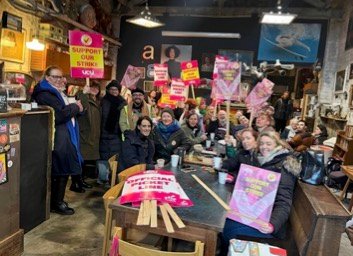
On a freezing cold January morning, dozens of FE lecturers, spread over various sites, were standing on the picket line for the first time ever. There were placards and music, chanting and laughter. A drama lecturer in pink fairy wings blew bubbles across the college gate, symbolically sealing it from traffic, while an SEN (Special Educational Needs] specialist bounced up and down blowing a horn with dance steps that wouldn’t have looked out of place at a nineties rave. A burly young lad, a sports teacher born when The Spice Girls were on Top of The Pops, stood joking with a tiny English teacher who had left school at sixteen during Thatcher’s recession, and found her first steady job half a decade later. Everywhere was the giddiness that comes when working class people take control of their lives, a feeling that the structures and hierarchies that bind half of their waking hours have simply melted away, leaving behind both disorientation and a sense of boundless potential.
A year earlier, our union branch had been moribund, only a quarter of those on the picket line had even been union members. So how did we build a fighting union?
Austerity’s quiet victims
A lot has been rightly said about the terrible desperation, poverty and even hunger that the Tories and Liberals inflicted on the poorest in our society: the malnourished children(1), the suicides,(2) the 330,000 deaths(3). When compared to these horrors, it is understandable that the collapse in wages and working conditions in some formerly middle class professions has gone under the radar. At our college, we suffered an enforced pay cut, followed by a pay freeze that lasted a decade. The union failed to react to the initial attack on conditions, and management followed this up with forced redundancies. In a classic example of proletarianisation, this deterioration in conditions took our members from a very comfortable position, to the edge of the precarious working class.
By 2024, the union was a shadow with a negligible membership, reps were present at only one of the college’s sites. But the anger needed to organise was everywhere among the staff.
It’s better to die on your feet…
In 2024, the management put forward a below inflation pay award that was accepted, with considerable bad grace. In 2025, the remaining union members were made another below-inflation offer, which was rejected. This was what allowed us to mobilise. Suddenly, we were talking in staff rooms to people who had always been radical but never in the union, and convincing them to join. This work was not done by the union committee, but the rank and file. The rejection brought an improved offer, that many of us wanted to reject in turn, but which was accepted under the recommendation of the committee. This confrontation with management led to a strong group of new and enthusiastic members forming, who were ready to convince their mates to join.
Fight for every inch
New reps and a new branch secretary were chosen in 2025, and suddenly sections where no union rep had been seen in a decade were hearing the word “union” every day. The key factor in this was fighting ferociously in sickness and disciplinary casework. We took on management in three cases where our members were being, gently but firmly, managed out, and saved every single job. Our belief was that, notwithstanding it being the right thing to do, other workers would see this and realise that the union was strong. You can’t ask people to fight for you until you have fought for them. Six months later, the formerly unorganised departments where the threatened members worked would become the backbone of the strike.
This refusal to compromise on our members’ jobs was combined with a policy we summarised, slightly vulgarly, as “if they say sugar, we say sh*te”. Our members’ interests were served if management were too exhausted from fighting us over small issues to introduce any more little bright ideas. After years of quietism and explaining why management were in the right to our members (and even if they weren’t, why we couldn’t do anything about it), this was a breath of fresh air for our colleagues.
It’s the members’ union
In an ongoing dispute, I can’t give too much information about the details of events that led us to strike for pay this year. I can say that the strike ballot was an amazing recruitment tool, and pushing for enough votes to cross the 50% threshold was a full time job. When the result became clear, management suddenly found extra money down the back of the sofa and made a better offer. We felt we could get more, but we had to leave it to the members to decide. We presented the offer neutrally, but it was rejected by a resounding majority. It is essential not to push the members towards a strike if they are not ready.
New times, new class
One of the most difficult things for me, as a man from an area and family with a strong union tradition, is to understand that my deepest values about never crossing a picket line are not shared by all my colleagues. Lecturers are, as I said above, a profession in the process of proletarianisation. Many of my workmates grew up in solidly middle class homes, and did not receive the same education on the values of the labour movement as I did. Even those who are culturally working class no longer live in communities where people will proudly say, as my father did, that they have never knowingly drunk with a scab.
The capitalist class has atomised our communities and class, and we cannot simply wish this atomisation away by appealing to the memory of a past culture. Nor can we simply write off potential members because they have crossed a picket line once. It will by my job, when we win the strike, to get to those non-members who let us down, and make them into good trade unionists, rather than writing them off forever. My mum and dad would be turning in their graves to hear me say that, but the solid working class of our childhoods did not appear from nowhere. It was built, and must be built again, through action, persuasion and hard graft.
1 Danny Dorling “Getting shorter and going hungrier: how children in the UK live today” in The Conversation, 16 Sep 2024
2 Karen McVeigh “Austerity a factor in rising suicide rate among UK men – study” in The Guardian, 12 Nov 2014
3 Walsh et al “Bearing the burden of austerity: how do changing mortality rates in the UK compare between men and women?” in Journal of Epidemiology and Community Health. 76:12 (2024)