
Labour gets a drubbing in the elections
By Martin Ralph
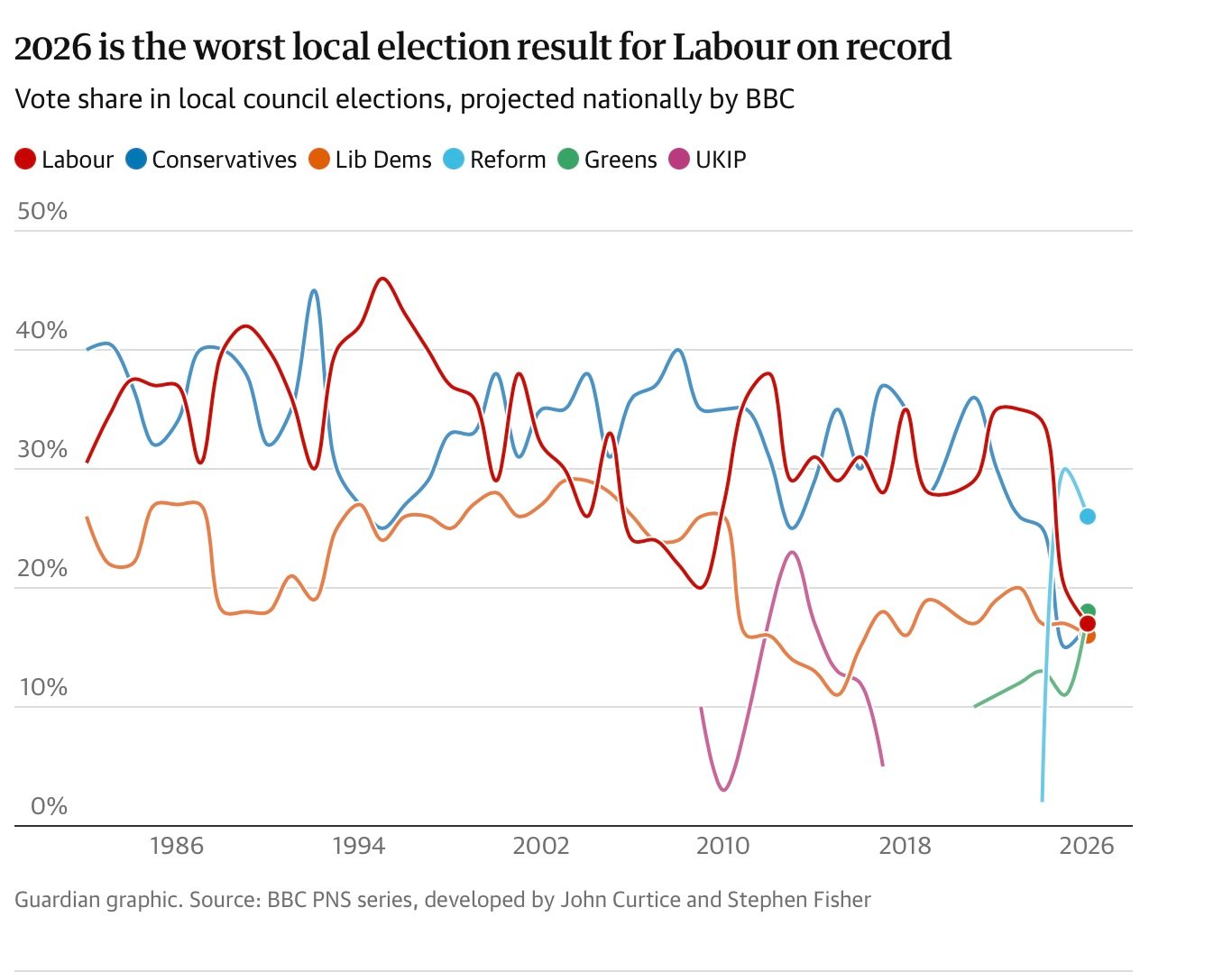
Over 25,000 candidates competed for 5,000 seats in one of the most hotly contested local elections in British history. Council seats were won on record-low vote shares, with an increased fragmentation of the 2-party electoral system driven by the loss of support for the two major parties.
| Scottish Parliament Election – seats won
SNP – 58 Labour – 17 Reform – 17 Scottish Green Party – 15
|
Senedd Election Wales– seats won
Plaid Cymru – 43 Conservatives – 7 Reform UK – 34 Labour – 9 Green Party – 2 |
England Local Council Elections
Labour lost 1498 (retaining 1068) Conservative lost 488, won 801 Liberal Democrats won 142 (total 844) Green won 440 (now 586) Reform won 1453 (now 1455) |
Support for the Labour and the Conservative Party collapsed, as support for the Green Party and Reform UK grew, with some increases in support for smaller parties and Independents. Labour lost control of councils 37 councils, the Conservatives 8. Liberal Democrats gained control of 3, the Greens 5, and Reform 14.
In Wales, Labour’s 27-year dominance was shattered as it suffered its worst ever result, losing most of their seats. The Conservatives also lost most of their seats. The Green Party and the Liberal Democrats made small gains, whilst Reform UK won 17 seats. In Wales Plaid Cymru (Welsh nationalist party) is the largest party and will form the new Senedd (Welsh government) as a sole minority government.
In Scotland, Labour suffered as the Scottish National party capitalised on a divided vote. Reform made gains largely at the expense of the Conservatives, as Labour failed to translate discontent with the SNP into gains.
While Reform UK swept through small-town England, the Greens outperformed their expectations in their target urban areas and in Hackney (London), where for two decades Labour has kept the mayoralty with at least a 25% margin. The Greens took Hackney’s mayoralty with a 12% margin. In Manchester, the Greens won 17 council seats and made sweeping gains in Sheffield and Newcastle, ousting the Labour leader.
Whilst Reform UK’s percentage decreased from last year they are no-longer seen as a fringe party but are accepted by the electorate as potential leaders of the country.
Reform is tapping in to growing fears among all social classes in the society about what some have called ‘Britain’s demographic timebomb’. In 1971, Enoch Powell claimed that ‘whites are being held back to accommodate the Asiatics and Blacks’.
In 1978, Margaret Thatcher stated she was ‘afraid that Britain might be rather swamped by people with a different culture’ and that there was a need to ‘control immigration to maintain good race relations’.
In May 2025, Keir Starmer said that Britain needed to ‘take back control of our borders… Nations depend on rules – fair rules. Now, in a diverse nation like ours…these rules become even more important. Without them, we risk becoming an island of strangers, not a nation that walks forward together.’ (Gus John, 20 May 2025)
Two years ago Keir Starmer won the general election by a huge margin, but the writing was already on the wall as Labour continued its shift to the right, using language and rhetoric similar to that of the far-Right against those seeking asylum from war torn countries. At the ISL national conference March 2025 we said, ‘Keir Starmer became Prime Minister on 6 July 2024 after the Labour Party won a landslide election with 410 seats that decisively swept the Conservatives out of power. Labour only won 33.7% of the vote and it was the lowest share of a vote won by any single-party majority government.’ The motivation of the majority voting for Starmer’s Labour Party in 2024 was to eject the Tories.
The stark losses suffered by Labour in the local elections follows the defeat in the Gorton and Denton by-election in February, a Labour seat since 1931, to the Green Party, with Reform coming second pushing Labour into third place. The Labour NEC barred Andy Burnham, Mayor of Greater Manchester, from standing as he was expected to win and then launch a bid for the Labour leadership to replace Starmer.
In the last two years, many (youth, women and workers) have witnessed and faced intense attacks by Labour who oppose its support for Israel’s genocide against Palestine and the Israeli/US attacks on Iran (opposed by the majority of the population).
Starmer has expanded attacks on democratic rights to protest, making mass arrests (so far 2,700) of people holding a “Support Palestine Action” placard including disabled people. Labour is applying the definition of terrorism to non-violent protest including the disabling of military hardware that is being used against Palestinians by Israel.
As Trump/Israel fails to subdue Iran as they want, a wider conflict across an international area which has created a disruption to Middle Eastern oil supply leading to some countries lifting sanctions on Russian oil because global markets cannot function without it.
The First Past the Post (FPP) electoral system, used for over 75 years, was established in 1950 with each MP representing a ‘roughly equal population’. The two party system provided British capitalism with an underlying stability, generally keeping smaller parties out of parliament and councils. So FPP created a stability that has now gone with Reform and the Green Party gaining from a great dissatisfaction with the economic and social policies of the two mainstream parties.
British Crises
The crises’ facing Britain are deep and arise out of a long, historic decline and decay of British capitalism and imperialism. As a result millions of people now suffer daily from all problems which the Labour government has failed to address. In 2010 there were 35 foodbanks for people who could not afford food whilst the combined wealth the richest 1,000 was £248 billion. In 2024 there were 3,572 foodbanks with the richest 1,000 owing more that £1 trillion.
In the 2024 General Election, the far-right Reform UK got 5 MPs and several pro-Palestinian Independent candidates won formerly 5 safe Labour seats. Reform won votes by targeting and demonising immigrants and people traveling to the UK in ‘small boats’ to claim asylum.
All the main parties have exploited the endemic and systemic racism in this country in encouraging the blaming of immigration and ‘Black and Global Majority’ people for a whole host of economic and social problems such as the cost of living crisis, lack of and poor social housing, cuts in public services and the NHS. This led to increasing overt racism and xenophobia and the ascendant position of Reform.
Your Party
The Labour Party lurch to the right created the space for a new party of the working class. In 2025, when the Your Party website called for support under the leadership of Jeremy Corbyn (expelled by Starmer from Labour) and Zarah Sultana, 800,000 responded. Corbyn was not ready to quickly launch the new party, but action from Sultana and her team pushed the project forward leading to the national conference when Corbyn and his team were the elected leadership of Your Party.
In the local elections YP supported various left candidates, independents and community groups including 30 YP members, overall with a couple of hundred candidates. The candidates winning seats were from independent groups which already held seats (mainly defected from Labour) and a few individual people who retained their seats. YP currently has around 29 official YP councillors and around 100 councillors who are members of the various affiliated groups.
Green Party
A rift within the YP party leadership created a space that led to a rapid rise in support for the Green Party, with a record number of members signing up (from 55,000 to 230,000) to Zack Polanski’s eco-populist vision, his support of Palestinian rights and vocal criticism of Israel’s actions in Gaza, more militant approach to Palestine, unconditional pro-trans policy, comprehensive nationalisation of UK public utilities – specifically gas, energy, and water, reflecting an old left social democratic programme and going further than YP. However, the Green Party is not a socialist party.
The Greens arise in a struggle against Reform where during the February by-election in Manchester they were able to mobilise 2000 people to actively campaign. The local elections shows that voters are willing to break from traditional political parties creating an interesting debate about the future and how to face the problems.
The Labour Party is a capitalist party and will continue its offensive and disenfranchisement of the working class and poor people. Labour is now desperate to reclaim its lost working class base so has endorsed Burnham’s candidacy in Makerfield, who they hope will challenge Starmer in a leadership contest. However, even Burnham’s leadership will amount to nothing more than a re-organisation of a failing capitalism that will follow the same racist, pro-Zionist, anti-working class, pro-capitalist path.
Blaming, criminalising and demonising immigrants for the mountain of economic and social problems has become the norm. The problems are a result of deregulation, greed and theft by big businesses, banks and financial institutions, along with government support for war and devastation. Capitalism/imperialism extends control to enrich themselves and help the economic dominance of the US superpower which is being challenged by the rising powers of Chinese and Russian imperialism, a world change that is driving events in Britain and across the world.
A programme for the working class needs goes beyond reform and must address the policies and systemic culture of racism and colonialism in this country, the discrimination and ill-treatment of refugees and asylum seekers, and must point towards revolutionary change. Workers and oppressed people will have to build their own party and programme, the application of which means establishing their own political and economic power. This can be done by making alliances in the unions, communities, students and organisations of the oppressed.
The strike wave of 2022/23 began to show the power of workers, a unity in struggle is needed to show that power again. The International Socialist League will help build that struggle.