
The crisis in Cuba: There is a real fight against Trump
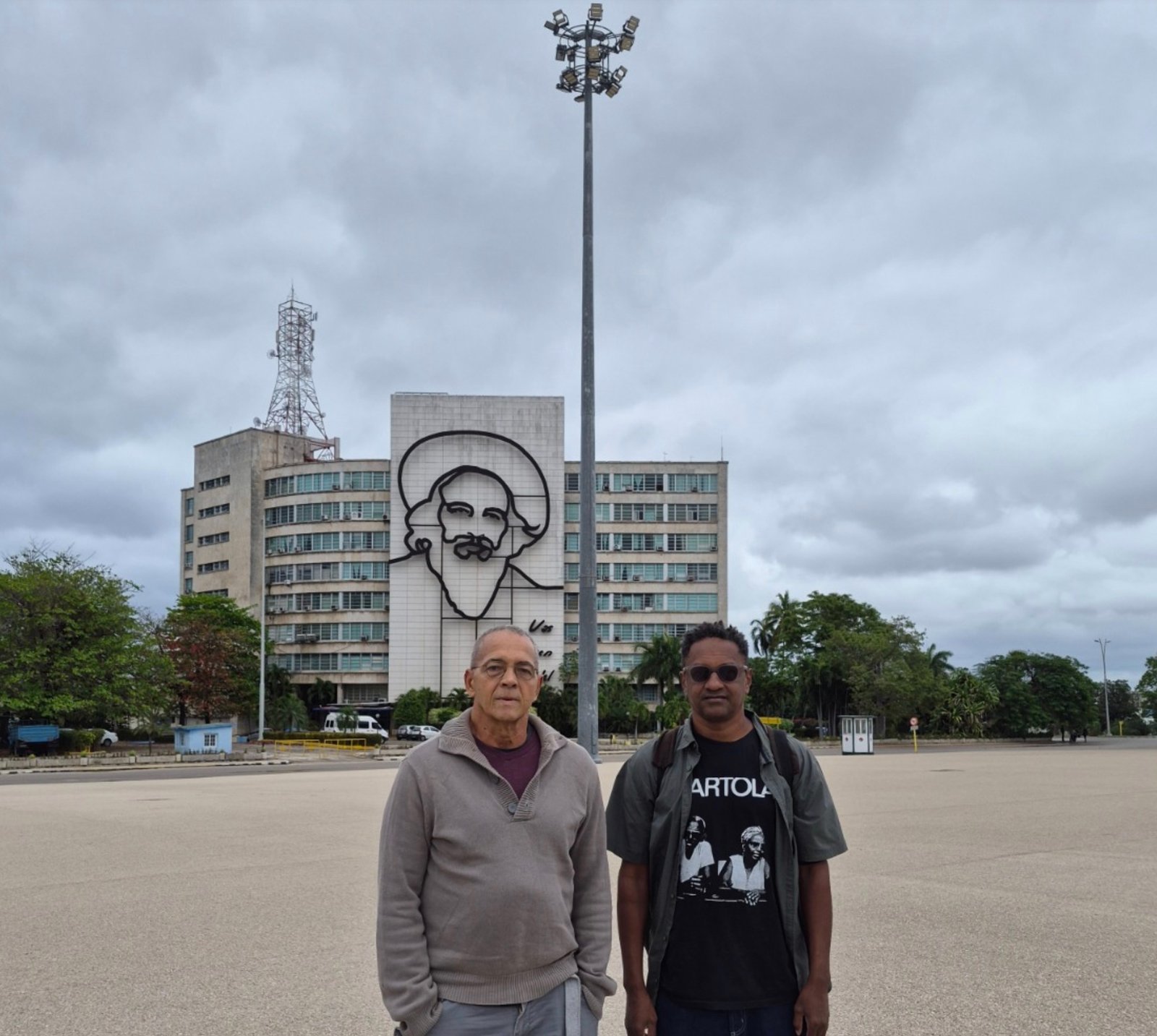
A small delegation from the IWL was in Cuba in March 2026. We studied there Hertz Dias (candidate for the presidency of Brazil for the PSTU), Gabriela (also from the PSTU) and yo.
We wanted, first of all, to show our solidarity with Cuba at this moment in which the sordid blockade imposed by Trump impedes the arrival of oil and strangles a small island, 140 km from the United States.
We made sure to be there on March 21st, close to the arrival of the Solidarity Flotilla to Cuba, in which several international organizations participated. We take what we can as a sign of solidarity, within our possibilities: food and medicine.
The international situation was marked by the imperialist-Zionist military aggression against Iran, immediately after the invasion of Venezuela and the kidnapping of Maduro.
Everyone knows that we are critics and opponents of the Cuban dictatorship. But this does not change our defense posture of Cuba, a semi-colonial country against the attack of the most powerful imperialist country on the planet. But even when this country is run by an extremely right-wing government that blatantly claims that it is going to “take over Cuba”.
Those who believe that Trump’s intentions have something to do with democracy are mistaken. American imperialism supports the worst dictatorships in the world, such as Saudi Arabia, always when it serves its interests. Supports Israel’s brutal repression against Palestinians.
Trump wants to reverse the decline of American imperialism and thus confront rising Chinese imperialism by openly using his military and economic power. In a document on National Strategic Security published in November 2025, it explains the objective of imposing government leaders in Latin America.
In Venezuela, with the military invasion, he achieved what he wanted: oil control and a change in the government of the country, with Delcy Rodríguez aligned with his interests.
The American blockade was imposed by John Kennedy in 1962. Now Trump has brutally worsened the blockade and wants to strangle the Cuban economy, with the suspension of oil shipments to the island.
Electricity generation in Cuba depends on oil between 80% and 95%. The system, old and in poor condition, is supported by two main thermoelectric plants. In the hub there is no modernization and no necessary maintenance.
Cuba needs 110 thousand barrels of oil every day, and only produces 40 thousand. The suspension of the Venezuelan oil supply, which supplied between 30 and 40% of Cuba’s needs, is a very hard blow for the island.
It has a colonial character as sordid as the appropriation of Venezuelan oil, which Trump now says is “owned by the Americans”. This type of attitude refers to the acts of colonial empires over their colonies in past siglos.
Trump declared a “national emergency” against Cuba, threatening to increase the costs of countries that supply oil to the island. This was accepted by the so-called «progressive governments»: not Lula, not Petro, not Claudia Scheinbaum, the three governments of oil exporting countries that did not supply oil to Cuba, accepting Trump’s imposition.
The consequences are serious. The lack of constant electrical energy also directly affects the supply of water and gas in a country that is in recession. There is an ongoing humanitarian crisis.
A public reception of the flotilla was announced on the 21st, but it never took place. As the Cuban dictatorship is very afraid of open acts, because it can turn against one another, only closed acts will be held, exclusively for international delegations. None of them were publicly summoned.
We tried through all media to find out when the event would be to see if we could participate. We only assumed that a closed act took place on March 20th the next day. Díaz-Canel, president of Cuba, participated in this act, giving a very left-wing speech against Trump.
On Saturday we were on two occasions on the Malecón (the traditional promenade of La Habana), where it was assumed that the flotilla would arrive. There was nothing, no boats arriving, unless we could see.
We deliver the food that we bring to an initiative of Cuban activists with whom we have contact, of solidarity cooking.
The medicines (antibiotics used in Brazilian hospitals for more serious infections) were delivered directly to the Cuban government, at the Instituto Cubano de Amistad con los Pueblos, from where donations delivered to the flotilla were delivered. Hertz and we present ourselves as the PSTU and the LIT and we deliver the medicines.
When leaving the institute, one of the activists present told us that, in that brief period of a few minutes in which we were delivering solidarity, an act had been carried out, also closed, with about a hundred people who were there, chanting “Cuba alone, I block no”. This was the second closed act, the only ones that took place during the week we were in Cuba.
We thus fulfill our objective of solidarity with the Cuban pueblo. However, beyond the denunciation of the imperialist blockade and immediate solidarity with Cuba, it is necessary to debate how to really fight against imperialism. Here we are facing two opposing strategies in reality: the Cuban government, supported by Stalinism at a global level, and what we defend
To understand this debate it is necessary to go back over time, to the history of the island.
1959: the first socialist revolution in Latin America
By defeating the Batista dictatorship and advancing the expropriation of large American companies, the revolution led by Fidel Castro and Che Guevara gained enormous prestige among the masses and the vanguard of the entire continent. Cuba was the first and only country in Latin America to carry out a victorious revolution in 1959, declared socialist in 1961.
The LIT (and the Bolshevik Faction, which preceded it) has always opposed the American blockade against Cuba, since its imposition in 1962. Likewise, we opposed the attempted invasion of Cochinos Bay in 1961.
However, the Cuban regime never developed the institutions of working democracy like the Soviets of the Russian revolution of 1917. Since 1959, there has always been an authoritarian regime, controlled by a bureaucracy, which was often linked to the Stalinism of the USSR.
Thus, the achievements of the Cuban revolution within the scope of education and health showed the world the possibilities of advancing with the expropriation of the bourgeoisie and the planning of the economy. Infant mortality rates in Cuba were lower than those in the United States.
A single-party regime was imposed, which constantly persecuted and repressed all opponents and critics, including those from the left. The unions were incorporated into the control of the State, closing central spaces for the expression of the change proposals of the working class.
In Cuba there is racism, machismo and LGBTQIphobia. As part of the same Stalinist model, in the realm of bureaucracy there has always been a continuation of these oppressions and repression against activists who oppose them. It is no coincidence that the 2019 march against LGBTQI oppression was repressed. It is no coincidence that the Cuban ruling elite is white, from the Castro family to Díaz-Canel today.
The restoration of capitalism in Cuba
The Cuban bureaucratic labor state does not exist. After the restoration of capitalism in the USSR, Cuba followed the same path. In the 1990s, the Castro regime itself ended with the monopoly of foreign trade and economic planning, and began to privatize state-owned companies.
The Cuban economy opened up to multinational companies, which was used by European imperialism to occupy the island.
From then on, a new Cuban bourgeoisie began to emerge, from the state apparatus, in particular from the top military leadership, associated with European multinationals.
The Central Planning Board, which directed the planned economy, was unsuccessful. At that same time, the State’s monopoly of foreign trade ended.
In September 1995, the National Assembly approved the Extranjeras Inversiones Law. Thus, the third pillar of the economy of the ancient working State, the state property of the main means of production, was being destroyed, sector by sector. State companies were handed over to European foreign capital, particularly through joint ventures (mixed companies).
A change is also required in the engine of the economy, which is now tourism, with Spanish multinationals such as Meliá and Iberostar controlling the large hotels in Varadero and La Habana for European, North American and South American middle class tourists. The idea was to occupy a place in the tourist market between the Caribbean beaches, competing for space with Punta Cana (Dominican Republic) and Cancún (Mexico).
The Cuban ron is controlled by the French company Pernord Ricard . Cuban purees are sold by a joint venture between the Cuban state company and Altadis , of the English group Imperial Tobacco Group PLC .
A new big Cuban bourgeoisie emerged at the top of the armed forces, from GAE (SA)- Grupo de Administración Empresarial SA, center and engine of the restoration of capitalism. This center was directed by Luis Alberto Rodríguez López-Calleja until his death two years ago. This character was the husband of Raúl Castro’s daughter (Débora Castro).
The GAE (SA) is associated with European multinationals, creates international companies from Cuba and now controls between 40% and 60% of the island’s economy, according to different scholars on the subject.
This has a profound meaning: the creation of a new Cuban bourgeoisie from the State apparatus, more precisely from the high military commands and from the family of Raúl Castro. This new Cuban bourgeoisie maintains control of the economy and regime in Cuba. Díaz-Canel is only a public figure, directly led by the Castro family.
Everything is embellished by Stalinism, which says that the changes in Cuba are expressions of «socialism in the present», distinct from past times. There is nothing Marxist about them.
Cuban society operates on the basis of the law of value and not on the basis of economic planning, nationalized companies and the monopoly of foreign trade as it previously existed in the old bureaucratic labor state.
It was under the pressure of the market and the law of value that the Cuban bourgeois State opted for tourism as the engine of the economy.
This worked at first, but it collapsed with the pandemic. Tourism never recovered 5 million annual visits, leaving last year at 1.8 million and this year, certainly, much less.
The State guarantees multinationals a skilled workforce without anyone having the opportunity to mobilize against low wages. It also guarantees the possibility of remitting earnings to its matrices without restrictions.
The inequality between Cubans, which existed in the bureaucratized working State, expanded greatly with the restoration. The new Cuban bourgeoisie and the social sector linked to tourism had great privileges and poverty began to be the rule for workers and the poor population of Cuba.
Why is the American imperialist bourgeoisie no more than the European bourgeoisie, being part of the capitalist restoration in the island? The explanation is in the Cuban bourgeoisie based in Miami, expropiated by the revolution in 1959. This bourgeoisie integrated into the American imperialist bourgeoisie and on the ground wants to return to Cuba, without overthrowing the Castro dictatorship and recovering its expropiated companies.
This change caused enormous confusion at the forefront of the entire world. Cuba continues to be governed by the Communist Party, but a fundamental transformation is taking place: before a bureaucratic dictatorship of a deformed workers’ state, after the restoration of capitalism, led by the Communist Party itself. However, with the support of Stalinism at a global level, they continue to speak of “socialist Cuba”.
Why did Cuba become isolated?
The only way for Cuba to advance towards socialism would be through the development of the world revolution and, in particular, in Latin America. But that didn’t happen. There is no possibility of advancing socialism on a single country, as was demonstrated in the USSR. Less aún on an island, like Cuba.
The current isolation of Cuba did not depend solely on economic support from the USSR. Not only because of the American blockade. These elements are important, but we cannot expect another response from the imperialist counterrevolution.
There is another factor, which is now decisive: the policy adopted by the Castro dictatorship. Castroism never sought to develop an international revolutionary strategy supported by the fights of the masses.
In the 1960s, the Cuban government made a disastrous attempt to expand guerrilla pockets in Latin America, isolated from the real movement of the masses. This led to successive defeats, the death of thousands of activists and facilitated the repression of bourgeois governments against the entire mass movement.
More seriously, after integrating into the Stalinist apparatus in 1972, the Cuban bureaucracy joined the Russian bureaucracy’s policy of “peaceful coexistence”, seeking support from the Latin American “progressive bourgeoisies”.
As the greatest example of this, before the revolutionary peak of 1979 in Latin America, after the defeat of Somoza’s National Guard and the seizure of power by the Sandinista Front, Fidel Castro opposed the fact that the revolution in Nicaragua was a «new Cuba».
Furthermore, Castro supported the actions of Contadora and Esquipulas at the beginning of the 1980s. These actions channeled the revolutionary peak into the election without leaving the elections, defeating the revolutionary process throughout Central America.
As part of the “peaceful coexistence”, the Cuban dictatorship supported bourgeois governments, such as López Portillo, Luis Echeverría (Mexico) and many others. There is much continuity with the “progressive” governments of Lula, Evo Morales, Michelle Bachelet, Cristina Kirchner, etc. But then, I looked for a connection with democratic governments in EE. UU., like Carter and Obama.
Finally, the Castro dictatorship helped the MPLA dictatorships in Angola and the FRELIMO dictatorship in Mozambique to follow the same path as Nicaragua. In these countries, following the defeat of the Portuguese armed forces, bourgeois dictatorships of these movements were imposed, with the management of new bourgeoisies, which have continued to govern for today.
This is the main reason for Cuba’s isolation. The strength of imperialism will always seek counterrevolution. But the truth is that the policy of the Cuban government, contrary to revolutionary processes, was the expression of the same counter-revolutionary policy of Stalinism throughout the world, which resulted in the defeat of innumerable revolutionary processes.
The policy to break isolation is not support for the «progressive bourgeoisies», but rather support for the fights of workers, regardless of these same government ones, pointing towards new socialist revolutions.
When the fall of the Stalinist dictatorships occurred in Eastern Europe, Cuba suffered the consequences of this policy, becoming extremely isolated.
Has the restoration of capitalism been completed?
Today there is a sector of world justice that is critical of Castroism and admits the existence of a process of capitalist restoration in Cuba. But I understand that this process has not been concluded and that Cuba continues to be a deformed workers’ state. From then on, they asserted that it was necessary to “defend the achievements of the Cuban revolution”.
These sectors generally commit three analytical errors. The first is to center the process of restoring capitalism in Cuba in the study of small production and commercial companies that are growing on the island, but do not control the economy.
You are wrong. This petty bourgeoisie does not determine the direction of the Cuban State and economy. It was the new bourgeoisie, emerged from GAESA (Grupo de Administración Empresarial SA), directed by the Castro family and formed from the State, which directed the restoration of capitalism and benefits from it. It is no coincidence that tourism is the engine of the current Cuban economy, based on large Spanish companies associated with Cuba.
Secondly, these sectors argue that capitalism has not been restored because there are still many state-owned companies in Cuba.
This is a theoretical and reality study error. According to Lenin and Trotsky, the class character of the State is determined by its relationship with the means of production, with the forms of property that the State defines and preserves. How to define a State that defends and preserves companies associated with European capital? In our view, it is a bourgeois State.
There is a temporal inequality between the change in character of the Cuban State, which occurred in the 1990s, and the economy as a whole, which began to be essentially capitalist a few years later.
This also occurred in the USSR. Gorbachev changed the character of the State in 1985, when he gained power and began the restoration of capitalism. But the restoration was only completed in the 1990s. In China, Deng Xiaoping changed the character of the State in 1979, when the restoration began, which was also only completed many years later.
How can you define a State as a worker, if there is no tripod that characterizes it? This is to say, without the central planning of the economy, without the monopoly of foreign trade, without state-owned companies at the center of the economy? It is a bourgeois State, which promotes and develops the restoration of capitalism.
The existence of many state-owned companies in Cuba is not a Marxist criterion to define the character of the state. In many capitalist countries there are state-owned companies, in varying quantities. It is essential to answer whether these state-owned companies are governed by economic planning, or whether they serve capitalist accumulation, as in other capitalist countries.
In China, for example, there are still many state-owned companies. Even the largest Chinese banks are state-owned and directly serve the capitalist accumulation process of large Chinese private companies. Y China is an imperialist country.
It is not possible to use a linear, quantitative and mechanical definition to define a single economy for many state-owned companies.
The Marxist criterion that defines the economy in its globality is that if the economy is governed by the law of value, by the market, supply and demand, it is a capitalist economy. If the economy is governed by the planning of the nationalized economy, it is a non-capitalist economy, at some point in its evolution.
Today Cuba is an economy governed by the market, with its evolution determined by the law of value. The option to focus on tourism was determined by the «market», by the law of value.
During the depression of 1929, the economy of the USSR — a working state, although run by the Stalinist bureaucracy — grew at rates exceeding 10% annually. In 2020, during the global recession, Cuba suffered a drop in GDP of 11%. Why? Because it has an economy determined by the market, in this case by the decline in global tourism, which strongly affected the main sector of the island’s economy.
Thirdly, these sectors argue that there are still achievements in education, health, sports, etc. But that doesn’t exist.
There is a brutal crisis in the country’s health and public education. Cuban activists denounce a brutal form of privatization through corruption. No one can get decent medical care in Cuba without paying “under the table” for anything, from a consultation to basic medicine.
An example of the Cuban health crisis was the terrible situation of the collapse of medical assistance in Cuba with the resurgence of the pandemic, very similar to what occurred in Latin American countries.
The programmatic consequence of this theoretical discussion is enormous. Which characterizes that Cuba continues to be a working State, it has as a program a political revolution that only modifies the political regime. Quienes, as others, we characterize that Cuba is capitalist, we defend a new socialist revolution, that expropiates privatized companies in hands of foreign capital, resumes the planning of the economy and the monopoly of foreign trade. And that breaks with the Stalinist dictatorship and builds a new democracy of workers.
We want to ask those sectors that continue to defend Cuba as a working State: What do they think should be done with the most important sector of the Cuban economy, the tourist sector, with the large private hotels? Is it necessary to expropriate the no? Should we not nationalize other multinational companies that control the country? Should we resume economic planning or not? Is it essential to return to the monopoly of foreign trade? If you answer these questions affirmatively, it means you are proposing a new socialist revolution in Cuba. If this program is implemented, it will help maintain the misery of Cuban workers.
The ancient Cuban bureaucratized labor state has disappeared, leaving its appearance alone, with the PC at its head, as in China.
What exists in Cuba is a bourgeois dictatorship
The most terrible consequence of the restoration of capitalism is the misery of the Cuban pueblo. There would be no material bases for July 11th or for the explosion that is taking place in Cuba without the economic and social consequences of the restoration of capitalism.
Contrary to what Stalinist propaganda says, the Cuban pueblo lives in poverty and hates the Castro dictatorship.
In December 2020, the Díaz-Canel government, expressing the interests of the new Cuban bourgeoisie, imposed the «Tarea Ordenamiento» plan, very similar to neoliberal plans from around the world.
The plan had as its declared objective the unification of current currencies in Cuba. But the result for workers was disastrous. What happened was a huge increase in gas and electricity prices, hyperinflation and terrible shortages. All in the middle of the Covid-19 pandemic.
But I’m not sure that everyone ends up losing. The true beneficiaries of this plan were the large multinational companies installed in Cuba and the new Cuban bourgeoisie associated with them.
The true explanation of the popular explosion of July 11, 2021 was this plan. The «11J» was a historic event that expressed the deep dissatisfaction of the Cuban masses with the dictatorship.
Poor Cubans are on the streets, in worker barrios. All very similar to the popular movements of 2019-2020 in Chile, Colombia and Ecuador.
Nothing to do with the movements of the right-wing middle class, of the richest neighborhoods, which sometimes occur in our countries, in support of the proposals of the bourgeoisie and imperialism.
The regime was hit hard by this spontaneous popular movement of masses and reacted violently with around 1500 arrests. The repression against workers and young people was supported by global Stalinism, with the slander that it was a movement organized by imperialism.
To date, there have been around 600 political prisoners since July 11, including many teenagers with sentences of 15 to 20 years in prison. There
We support workers’ struggles against neoliberal plans in Colombia and Chile and denounce the harsh repression of government officials. We support the 11th of July and denounce the repression of the Cuban government.
The “popular democracy” of Cuba, propagated by the Stalinists, is a farce. This dictatorship knows that it is hated and that is why it is afraid of its own pueblo. It does not allow any type of democracy, neither labor nor bourgeois. The self-styled «popular democracy» is not democracy, and much less popular.
The population suffers persecution and police surveillance all the time. Quienes discrepan pierden their jobs, they are monitored and persecuted.
The minimum wage in Cuba today is equivalent to 3 dollars. And that’s with the food, when you can get it, costing a similar price to those in Brazil. We also paid 2.4 dollars during our stay in Cuba, for a sweet egg dish – the cheapest source of protein we found. The sea, a teacher of huevos is worth as much as a monthly minimum wage.
The supply bill – the subsidized food guaranteed by the Cuban government in the past – was reduced to just one pan boy per person per day. There were important colas in front of the official bakeries in Habana, to achieve this pan.
Constant repression is the way in which this dictatorship prevents contrary protests and protests.
In the “elections” only candidates nominated by the government are allowed and the PC is the only legal party.
Why don’t we allow the existence of any left-wing party that doesn’t support the government? Why is there no free union in Cuba? The CSP Conlutas, a popular union center supported by the PSTU, would not be legal in Cuba.
The regime represses any type of opposition. Repressed the 11J, as well as the LGBTI march of May 2019, the independent artistic manifestations and all the acts that question it. The harsh repression empowers those who oppose exile or prison.
Since the 11th of July, the crisis has deepened more and more, as has the discontent with poverty and repression.
The current crisis is preparing a new popular explosion
This whole thing got even worse with the oil blockade imposed by Trump since Maduro’s dismissal. With the Venezuelan oil supply interrupted and the ban on any other country sending oil, Cuba is collapsing.
During the week we studied there, national and other local blackouts were produced. Despite being housed in a central neighborhood of La Habana, we spent more time without energy than with energy.
The rupture of masses with the government is enormous. We spoke extensively with the activists with whom we have contact. They speak of the hatred of the Cuban pueblo towards the dictatorship, both because of misery and constant repression. The Cuban pueblo compares its misery with the privileges of the ruling elite, which are known as those of Raúl Castro’s family.
This anti-dictatorial conscience is capitalized mainly by the law. There is important political support for Trump among the Cuban masses. Among activists there are different estimates about this phenomenon: some have around 60% support for Trump, others around 80%. This hard truth is important to understand the regression of the anti-imperialist conscience, once the majority in Cuba, due to the dictatorship.
Support for Cuban «socialism» is very minority, with an important presence among the sectors of the city, which experienced better moments in the former working State. The younger the population is, the greater the support for Trump.
A few days before our arrival, people from a small town —Morón— attacked and set fire to the headquarters of the Communist Party of Cuba.
During the period in which we studied there, every day we had local cacerolazos per la noche, without national extension or continuity.
A huge rebuke is unfolding against the bourgeois dictatorship that could be exploited in a new popular movement, even greater than on July 11, 2021.
The problem with campism
Stalinism, as a global apparatus, was greatly weakened by the fall of the dictatorships in Eastern Europe. But it continues to be very strong until today. He reports on communist parties in many countries, some of them with great popular influence. Many non-Stalinist reformist parties, such as the PT and PSOL in Brazil, support the Castro dictatorship.
But Stalinism is much more than authoritarianism is well known and repudiated. It has a reformist ideology that has a much greater reach than the communist parties themselves. Replace the method of Marxist analysis of social classes with that of «progressive fields».
On the one hand, there would be «progressive fields», which included «left government» and «progressive bourgeoisie». On the other hand, there would be the enemy, American imperialism. I only recognize the North American as imperialism, ignoring both European imperialism and Chinese and Russian imperialism.
Therefore, all those who oppose these progressive governments are “agents of American imperialism”. In these countries run by these “leftist governments”, there are no real social classes, no class struggle. Only progressive governments and their enemies exist, the agents of American imperialism.
For the propaganda of many Stalinist parties, Cuba and China, in addition to having «left government», they continue to remain in «socialist» countries today. From then on, many PCs supported the massacre of Tiananmen Plaza in 1989. Even before thousands of dead young people in a peaceful demonstration in Beijing, the Stalinist apparatus continued to speak of «agents of imperialism».
China, contrary to what Stalinist propaganda says, is an imperialist power. With very low salaries and a dictatorship that represses any social threat, if the Chinese model was imposed, it was propagated by global imperialism as an example, creating a new salary paradigm, which contributed to lowering the standard of living of workers all over the world.
With this methodology of analysis of «progressive governments», the PC and their followers supported Assad, the Syrian dictator, who killed 500 thousand inhabitants to remain in power. Support Ortega’s dictatorships in Nicaragua. But, contrary to what Stalinist propaganda says, those who govern these countries are the new bourgeoisie that emerged from the State apparatus. In these countries there are workers who fight against the capitalist misery imposed by these governments.
In Cuba, the same campist method of Stalinism serves to justify all Cuban government policy as “progressive” and even as the “last bastion of socialism”. Therefore, they also supported the Cuban government’s repression against July 11th.
Thus, we have two dominant ideologies in the world regarding Cuba. One of North American imperialism, that socialism exists in Cuba and is a demonstration that socialism is equal to dictatorship and misery. Otra, from the Stalinist apparatus, that Cuba is “the last bastion of socialism” and that activists have to defend the Cuban government, on the ground against North American imperialism, but also against their own pueblo.
But these ideologies clash with reality. In Cuba there is no socialism of any kind. There is a bourgeois dictatorship, which is maintained by constant repression.
The campist ideology of Stalinism, which was the basis of countless workers’ defeats, is preparing one more for Cuba.
We both fight imperialism. And we also fought against Stalinism. For this, we use the Marxist method, which does not replace the fighting classes with «fields». We evaluate the relationships between nations in the global system of states. And we analyze the concrete situations of the class fight.
That’s why we fight the imperialist blockade against Cuba. This is why we can also fight against the bourgeois dictatorship in Cuba, independently of imperialism.
It is undeniable that Trump wants to take advantage of the current crisis of the Cuban government, and that he is disputing the conscience of the Cuban masses.
This affects the part of the ancient anti-dictatorial vanguard on the island, as part of the directions of the San Isidro Movement, present in Cuban culture, which went to the right.
On the other hand, the Stalinist apparatus also acts to break this vanguard, with arrests, trials and defamations. Furthermore, it exerts ideological pressure, with the farce that all the movements that arise «have imperialism behind».
Fortunately, there are not only those from the fields. A sector of the Cuban vanguard is at odds with imperialist maneuvers and against the Castro dictatorship, as is the case of the Socialistas en Lucha group, which shares with us the fight against imperialism, against the dictatorship and the defense of socialism.
Cuban government negotiations with Trump
For some months now, there has been information about direct negotiations between the Trump government and the Cuban regime. The press openly discussed the proposal for a “Venezuelan” departure for Cuba.
Trump said in February of this year: “The Cuban government is talking to us. It has a lot of problems and no money. It doesn’t have anything right now, but it’s talking to us, and maybe we’re having a friendly takeover. We could end up having a friendly takeover of Cuba.”
Who is negotiating with Marco Rubio (Trump’s secretary of state), on the part of Cuba, is Raúl Guillermo Rodríguez Castro, son of Raúl Castro, nicknamed “El Cangrejo”. In other words, these are direct negotiations from the centers of power on both the Trump and Cuban sides.
Trump’s release of a Russian freighter with oil to reach Cuba must have been part of these negotiations. Trump’s spokesperson has since pointed out that the North American government will review “case by case” the possibility of other areas. In other words, it means less than ten days of oil needed by Cuba.
Exactly on the day we arrived in Cuba, March 16, Díaz-Canel appeared on state television to announce the negotiations with Trump, «with responsibility and great sensitivity». In front of him, sitting, was Raúl Guillermo Rodríguez Castro.
If the release of investments in Cuba was announced by «Cuban residents in the United States», it is decided, by the Cuban bourgeoisie based in Miami, in the energy, general infrastructure and financial sectors.
These investments can be carried out without any control by the Cuban State. That is, the handover of the Cuban economy to North American imperialism through negotiations with Trump was announced.
It was at that moment that Trump declared that “it would be a great honor to take Cuba”.
However, shortly afterwards, Marco Rubio, responding to Díaz-Canel, stated that these measures were not sufficient and demanded the opening of all trade and the resignation of Díaz-Canel.
Later, Díaz-Canel responded to Trump, both on social networks and in a closed act with the flotilla, stating that a military attack against Cuba was possible and that «the country had launched a defense preparation plan based on the concept of a war for the entire pueblo».
Along with this, I carried out a media operation. The singer Silvio Rodríguez, who supports the regime, but openly criticizes the repression, demanded a rifle from the government to defend Cuba against Trump. Díaz-Canel then handed over a rifle.
It was all a farce. The weapon given to Silvio Rodríguez, as he said later, was a replica, not a real weapon. There is no preparation for a popular operation to defend Cuba. During the time that we were on the island in the hub, there was no movement of masses or real preparations for popular weapons. Our remaining activists are unanimous in characterizing this popular movement proposal as a farce.
However, there is the possibility of an impasse in ongoing negotiations. It is necessary to bear in mind that the Cuban bourgeoisie of Miami is part of the imperialist bourgeoisie. It has much more economic and political weight than the Venezuelan bourgeois opposition of María Corina Machado.
You could be on the verge of a “Venezuelan” exit in Cuba. It is, therefore, an open process, which could result in both an imperialist military invasion and a real negotiation to maintain a part of the regime, but subordinate to Trump (a la Venezuelan). Or, another hypothesis occurs.
How to really defend Cuba against imperialism?
In Cuba, a brutal pressure of imperialism is manifesting against a small semi-colonial country. This is the central element of reality at this moment.
On the other hand, a huge explosion is brewing against the Cuban bourgeois dictatorship.
We do not know how these uneven processes will manifest themselves or how they will combine.
Trump’s negotiations with the Cuban government could lead to a new alternative similar to that in Venezuela. This could result in a blockade in negotiations and end in an imperialist military invasion.
It could also happen that a popular explosion ends up being capitalized by pro-imperialist leadership, linked to Trump. Other hypotheses, more or less combined, can be given, with different results.
The Cuban government, for now, maintains a strategy of negotiating with imperialism, repressing its own population and not resorting to mass mobilization against Trump. The reasoning is always based on the same argument: the unfavorable power ratio.
There really exists, in military terms, a power relationship that is absolutely unfavorable for Cuba. But Cuban history has demonstrated that it is possible to defeat American imperialism. In 1961, there was a United States invasion of Cuba, in Cochinos Bay. A popular and military movement defeated the imperialist invasion in 72 hours, ensuring a victory that consolidated the revolution in Cuba.
Extending the examples to the Latin American reality, in 2002 a popular movement defeated the attempted coup d’état perpetrated by the Venezuelan armed forces against Chávez. And, the best-known example of all, in 1975 a combination between the heroic military resistance of the Vietnamese and the mass movement against the war in the United States led to the greatest political and military defeat of American imperialism until it closes.
At this moment, the combination between the Iranian military resistance and the movements in the United States could lead to a new and great defeat of imperialism in the Iranian war.
There is no possibility of changing this unfavorable power relationship without the combination of military resistance and mass movement, inside and outside Cuba. Solo really preparing a popular armed resistance in Cuba and uniting the movements with those existing in the United States – like those that occurred on the 28th of March «No Kings» and the next ones that will take place on the 1st of May – it is possible to change the unfavorable power ratio.
For this, it would be necessary for the Cuban regime to release political prisoners, call for the movement and deliver weapons to workers. Enough of farces like the one that occurred with the singer Silvio Rodríguez. It is necessary to seriously prepare popular military resistance against a possible imperialist invasion.
We understand that the Cuban dictatorship, at least until now, is doing the opposite. There is no mass movement within Cuba, no relationship with mass movements in EE. UU. A repressive stance is maintained against the Cuban pueblo, while dialogue and negotiations are held with Trump.
As I say to the mother of one of the teenage political prisoners of July 11 in Cuba, it is impressive that Díaz-Canel dialogues with imperialism and not with the Cuban pueblo. Among the 2000 prisoners released by the Cuban government through negotiation with imperialism mediated by the Vatican in the hub of 11J prisoners.
The Cuban government wants to end the blockade so that American imperialist companies can defeat Cuba, just like Spanish, French and Italian companies do today. The Cuban government wants to end the blockade to advance the semi-colonization of the island. Now, he is negotiating with Trump, which could mean the lack of the possibility of a “Venezuelan” exit to Cuba.
In addition to organizing a true resistance against American imperialism, we propose to fight against the Cuban dictatorship as part of a democratic fight, part of a socialist and anti-imperialist strategy.
We defend an independent movement and organization of workers and the Cuban community. We demand freedom for political prisoners and the free organization of trade unions and political organizations in Cuba, to be able to better combat imperialism.
This democratic struggle forms part of our strategy for a new socialist revolution in Cuba, re-nationalizing privatized companies, including those that are in the hands of European imperialism, with economic planning and direct and real control of workers. We want a working democracy in Cuba, opposed to the Stalinist dictatorship, which has its essence in the participation of workers in all the fundamental and strategic decisions of the island.
The left-wing activists who defend the Cuban dictatorship, thinking that, despite errors, Stalinism defends the fall of the Cuban revolution, they must reflect.
The Castro dictatorship is not defending the bureaucratized worker state that has not existed for a long time, despite its alliance with large European companies, their gains and privileges. That’s why I’m hated by the Cuban pueblo. The Cuban dictatorship is not facing Trump, at least for now, even though it is negotiating with the United States.
Uncritically supporting the Stalinist dictatorship is strengthening this vision of «progressive fields together with the bourgeoisie», which ignores social classes and Marxism. And he is preparing a new defeat in Cuba, now at the hands of the American government.
We, since the IWL, on the ground defend Cuba against American imperialism, even though we are betting on the defeat of imperialism together with the movement of masses within Cuba and in the United States. We are willing to support any real measure from the Cuban government to defend the island and face Trump. What we are not in agreement with is its negotiation strategy with the American government.
We defend the side of workers and youth in Cuba. We consider that your fight is legitimate, fair and necessary. One cannot deny the reality of profound economic inequality and the existence of the repression of democratic freedoms. The true way to fight against imperialism is, as history teaches, supporting the Cuban masses and the world, and not against them.